
By: Amaris Gutjahr

As the United States Immigration and Customs Enforcement (ICE) “cracks down” on supposed illegal immigrants who are the “worst of the worst,” whole communities are adversely affected.
ICE was formed as part of the Homeland Security Act of 2002 in response to the September 11th terrorist attacks. The ICE agency was originally responsible for removing unauthorized people from the US and stopping the smuggling of immigrants into America. Recently, the prerogatives of ICE seem to have changed as raids are conducted with indiscriminate aggression and violence. “Where is the de-escalation?” Danielle Walker demands.
Right now, the impacts of the ICE raids are most visible in Minnesota. Many residents feel that the streets of Minneapolis are dangerous as they witness their neighbors being harmed by ICE agents, immigrants, and protesters alike. “It’s clearly not about criminals. They’re arresting anyone without reason and making people afraid,” a resident of Minneapolis commented.
Some instances of ICE brutality in the Metro area include the shootings of U.S. citizens Renee Good and Alex Pretti. Good was a mother of three who had committed no previous law violations. During the confrontation, phone recordings showed Good attempting to drive out of the parking lot. The ICE agent in front of the driver’s side of her car shot Good in the head before stepping to the side of the turning vehicle, which had its wheels facing away from his direction.
Pretti was a 37-year-old intensive care unit nurse who reportedly was legally carrying a firearm when ICE agents confronted him. Footage from a bystander shows that when a woman was shoved to the ground by an ICE agent, Pretti tried to assist her, only to be tackled by ICE agents who then shot him to death. Pretti hadn’t even drawn his gun.
Good and Pretti are two out of eight American citizens killed by ICE since the start of 2026, according to Milessa Hellmann’s article for The Guardian. “Murder is happening, and ICE isn’t being held accountable,” a Wesleyan student said.
These killings have sparked widespread protests, which ICE officials don’t take kindly to. ICE agents have reportedly assaulted spectators with pepper spray, attempted to disperse peaceful protestors, and threatened civilians who were recording them. “They’re clearly violating the First Amendment,” a Minnesotan resident stated.
This lack of de-escalation from ICE agents could be a result of inadequate training. According to former ICE Academy instructor Ryan Schwank, ICE cut training almost in half. Classes removed include those teaching about the Constitution, due process, and use of force policies. “We need to closely monitor or at least review training changes made to academy training,” Professor Travis Zimmerman said about ICE.
Lack of training isn’t the only problem. The mask-wearing habit most ICE agents have creates an environment of distrust. “The KKK clan wore masks. The Proud Boys covered their faces,” Walker pointed out. “Are you agents or are you vigilantes?” Walker questions. Even more troubling, masks “make it hard to identify perpetrators of misconduct,” a Wesleyan student remarked.
Ultimately, the actions of ICE appear to bear more negative consequences than actual benefits. While some states like Minnesota are resisting ICE involvement, West Virginian officials have welcomed and assisted ICE officers.
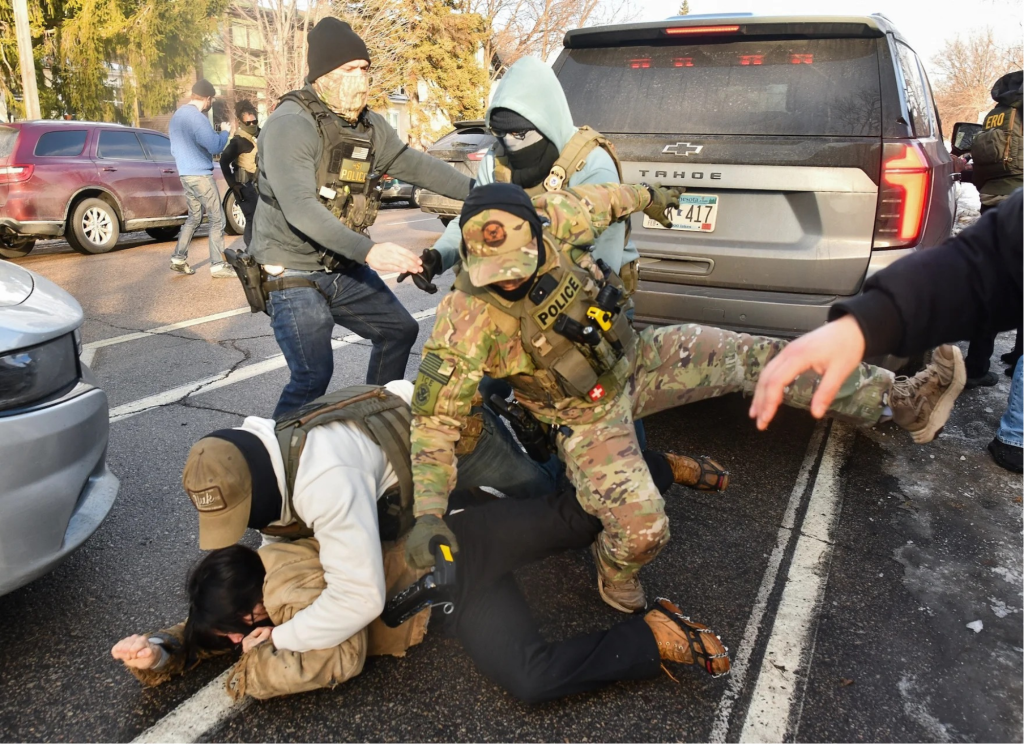
Minneapolis, Minnesota, January 13,2026 (Photo by Octavio Jones / AFP via getty images)
 THE PHAROS
Leave a comment