
By: Ashton Nardella

On October 18th, an estimated seven million people showed up for the second No Kings Protest, making the event one of the largest protests in United States history.
On June 14th, the first No Kings Protest was held. Its purpose was to counteract the military parade that took place on President Donald Trump’s birthday. Many Americans critiqued this parade, citing its hefty cost (anywhere from twenty-five to forty-five million dollars), as well as the lack of precedent for a military parade during peacetime.
Since then, what started out as a single day of resistance has grown into a full-fledged movement, with over 2,700 events in all fifty states. This collective outrage is due to the Trump administration’s sowing of chaos through its slashing of federal funding, unlawful detention of people, and criminalization of political opponents.
Despite much of the state being considered Trump Country, West Virginia held host to several protests from Morgantown and Fairmont to Clarksburg and Buckhannon. There was even a one-woman protest in Beckley, who made signs based on The Big Lebowski.
Claire Kosky is a student here at West Virginia Wesleyan College, who attended the second No Kings Protest in Elkins, WV.
“America at its true core is about no kings, and there’s also just plenty of political atrocities that Trump has committed since going into office,” Kosky said, “With the ICE basically kidnapping [people] and things like that. I believe that a country should not be run that way.”
Despite, or perhaps because of, the heavy subject matter, many protesters have found ways to lighten the mood.
“There were people […] playing guitar and singing and some people were selling shirts and things like that,” Kosky said.
Blow-up Halloween costumes have become commonplace at protests like the No Kings — especially the so-called Portland Frog, a new symbol of resistance. A little bit of silliness goes a long way, and shows people that protesters are not a threat.
Despite a mostly positive experience for protestors, there were some detractors.
“There were a couple of cars that drove by that weren’t very happy. One truck rolled coal on us,” Kosky said.
To clarify, rolling coal on someone means a vehicle slowing down to a stop in order to blow smoke from the exhaust pipe on a passerby.
However, the Elkins group ignored these kinds of disruptions.
“The government is debating our human rights every single day,” Kosky said, “These are our rights. These are our livelihoods. Our jobs, our futures, and we have the right to push back against anybody who’s trying to take them away from us.”
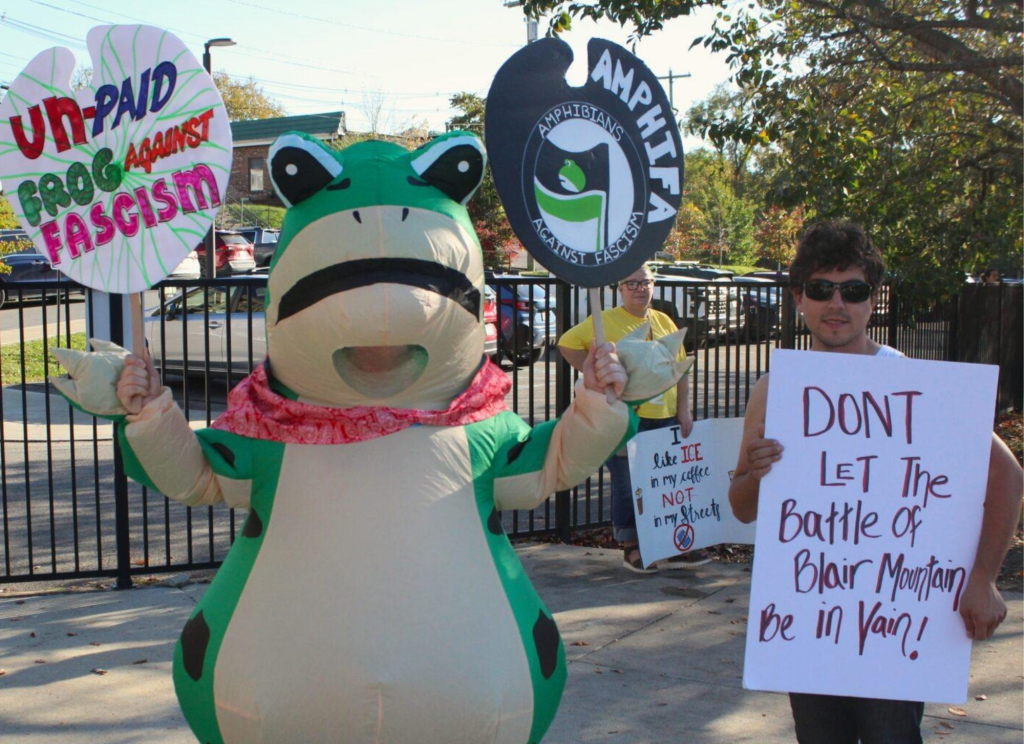
Taken from Chris Schulz/West Virginia Public Broadcasting
 THE PHAROS
Leave a comment